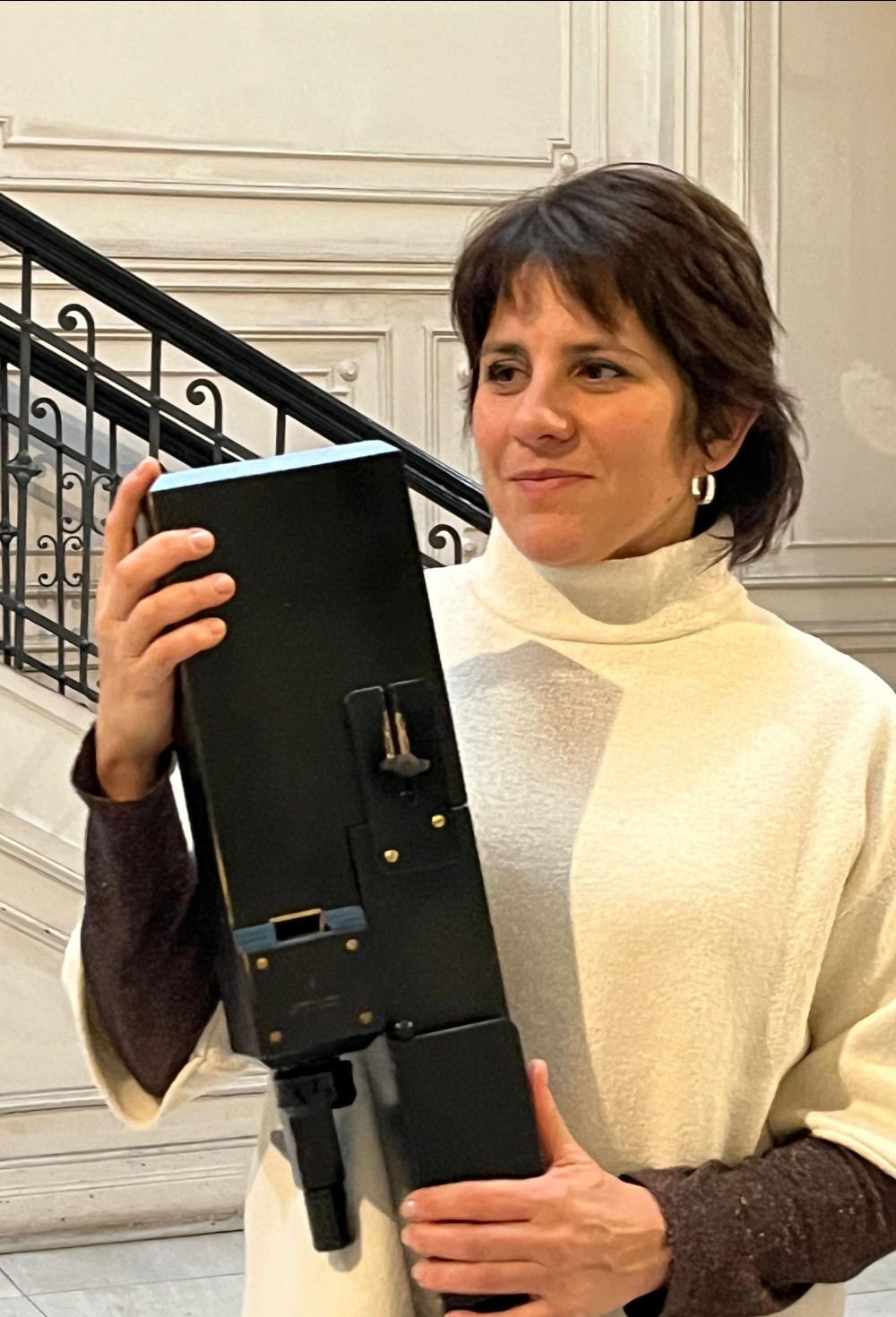
Visiting Researcher
Paola Muñoz Manuguián is a performer-researcher and PhD candidate at the Pontificia Universidad Católica de Chile. Her research unfolds through a practice she calls trans-creation. This is a proposal that regards musical works not as texts to be represented, but as catalysts. Imagine them as generative frameworks through which extra-notational phenomena (kinetic, sonic, and visual) can be both analyzed and experienced. In this way, polyphony extends beyond sound, emerging through the layered and multidimensional interactions between performer, space, and instrument.
Drawing on the ontological and epistemological contributions of thinkers such as Deleuze, Guattari, Simondon, and Paulo de Assis, her work challenges conventional hierarchies between composer, performer, and instrument. She reconceptualises interpretation as a generative, dynamic process that engages the imperceptible: memory, latency, resonance, and spatial dramaturgy. Her artistic research incorporates elements from real-time electronics, video, and psychophysiological data (e.g., EEG), constructing multisensory, performative assemblages that blur the boundaries between sound, space, and image.
Her current projects include a trans-creation of Stockhausen’s Solo, merging historical and modern recorders, electronic media, and generative video based on neural data; and Resonant Shadows, a site-specific performance for Baroque alto recorders, which explores resonance, architecture, and projected memory as compositional forces. In both, the recorder becomes a vehicle for what she calls “epistemic and sonic transductions,” expanding the sonic and conceptual vocabulary of performance.
She is currently undertaking a dual research residency at the Orpheus Instituut (2025–2026), where she collaborates with Paulo de Assis, Juan Parra, and Diego Castro Magas. Her work aims to contribute to current debates in artistic research, performance studies, and the ontology of musical works.