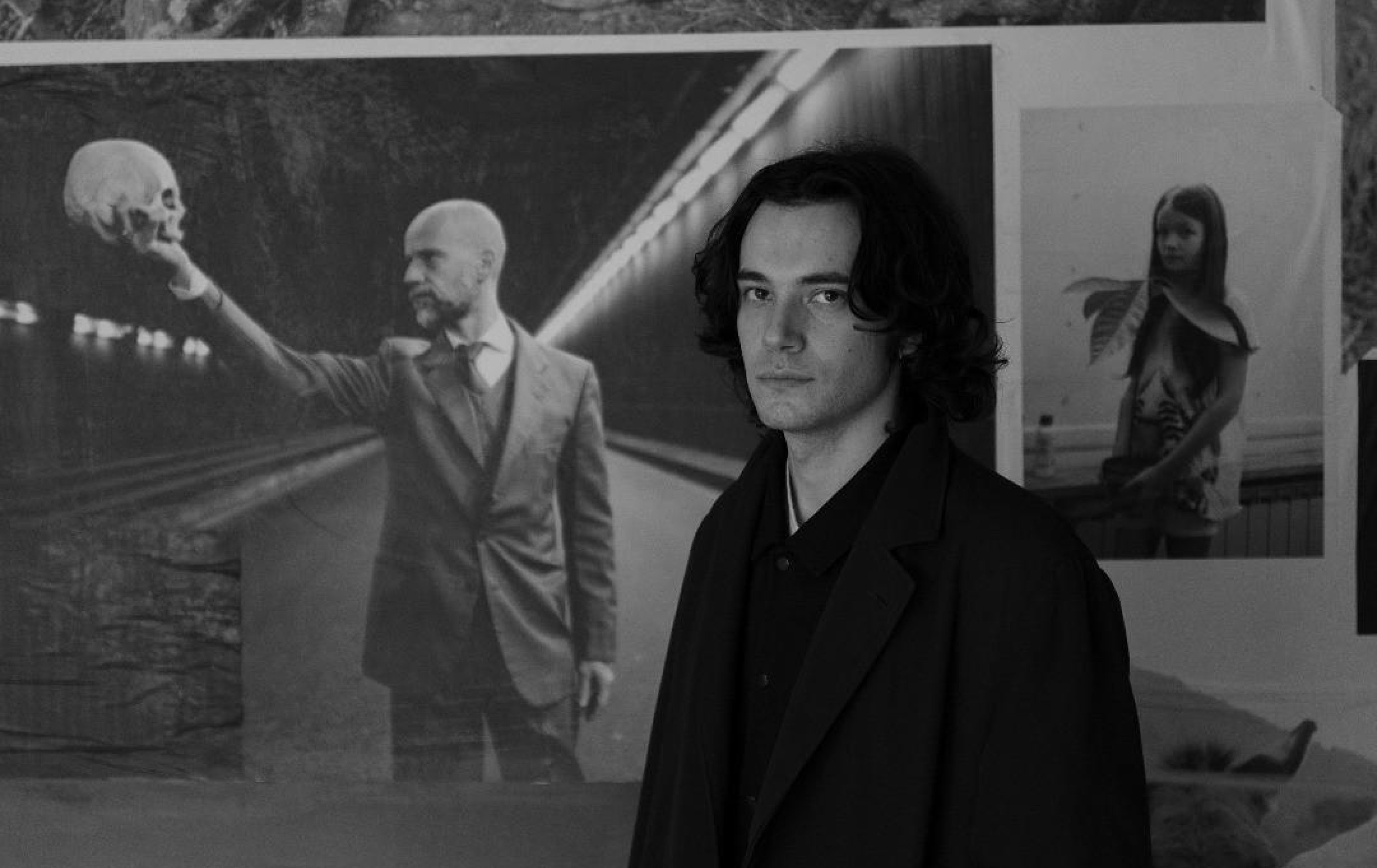
Orpheus Instituut welcomes Guglielmo Diana as visiting researcher
News January 15, 20268 January - 8 June 2026
His project investigates how open, reactive instrument systems reshape compositional thinking and performative agency, bringing together instrument-making, experimental performance, and theoretical inquiry to explore the shifting boundaries between control, indeterminacy, and posthuman musical practice.
Guglielmo Diana is a PhD student at the “Giuseppe Verdi” Conservatorium of Turin, working in the field of Sound & Music Computing and Cultural Heritage. His research examines how human composition and performance evolve when interacting with open, indeterminate systems, particularly instruments that challenge or destabilise fundamental musical parameters such as pitch, amplitude, and action. Within this framework, he is developing a corpus of hybrid chordophones, called Chelys Sonorum. His initial approach emerged from a found “franken-guitar,” reconfigured into a pseudo-autonomous instrument.

A found “franken-guitar” © Guglielmo Diana
As a student and an improviser, he has always tried to stay between control and loss of control of the instrument; this study therefore aims to find new approaches grounded in the desire a negotiation of control our tools. Reflecting the idea that the tool makes the toolmaker as much as the toolmaker makes the tool, he seeks to rethink string instruments in an evolutionary sense, where their design undergoes a form of natural selection.
From this perspective, instruments are viewed as open systems rather than closed ones, capable of influencing how we behave in a posthuman way.
Guglielmo Diana’s visit at the Orpheus Instituut follows his participation in the 2025 Sound Craft Summer School, during which he developed an early prototype of Chelys Sonorum.
The Summer School provided a fertile environment and highlighted the institute’s emphasis on the mutually generative relationship between theory and practice.
During his stay, he will further develop the Chelys instruments and investigate their compositional and performative implications within an interdisciplinary artistic research context.
We warmly welcome Guglielmo to our institute and look forward to the insights and experiments his research will bring to our community.