CD // W. A. Mozart’s “Sonatas with Varied Reprises”, K 279–284
On October 6, 1775, Leopold Mozart inquired of publisher Breitkopf in Leipzig whether the latter might like to print keyboard sonatas by his son “in the same manner as those of H: Philipp Carl Emanuel Bach mit veränderten Reprisen.” Scholars have proposed a link between Leopold’s offered works and Wolfgang Amadeus Mozart’s recently completed “Munich” Sonatas, K. 279–84 (1774–75). What might Mozart’s Six Sonatas with Varied Reprises have looked like? Reversely, what in Mozart’s score made Leopold think of a possible publication à la Bach?
Using Bach’s Wq. 50 as a guide, this recording extends a widely documented mid-eighteenth-century practice of embellishing repeats to the actual rewriting of Mozart’s reprises. Reprise here applies to either of the two sections of a sonata-form movement that are to be repeated. The expectation of such a repeat is crucial for our performing and listening to a “varied [repeat of a] reprise” in a rhetorical or pre-organicist paradigm.
That Bach’s printed opus was meant to demonstrate how “one tends to vary the allegros with 2 reprises the second time around” (Bach, 1753) raises the stakes for our engagement with Mozart, who left us with fine examples of embellishing slow movements but whose fast movements in particular leave us guessing as to how he would have handled such an exercise. The idea here is to build on previous studies of Mozart as improviser, but also to commit to a fully written-out, entirely publishable text. While Bach claimed to have invented a new genre “for the use and benefit” of the amateur, our challenge is to apply similar principles to what in Mozart’s household were known as “the difficult sonatas,” removing all repeat signs and replacing these with varied reprises.
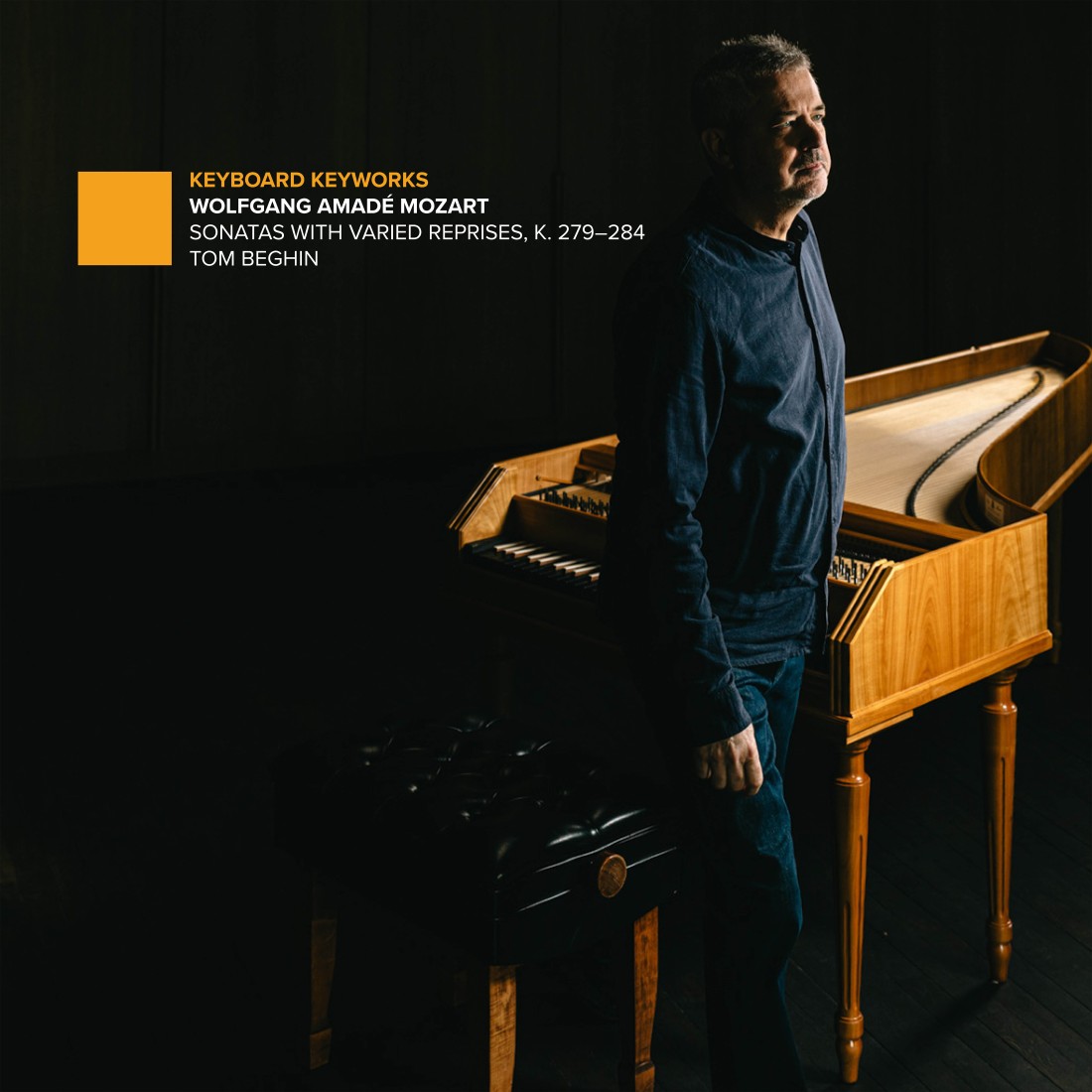
Tom Beghin plays a replica of Andreas Stein built by Chris Maene in 2016 from the Orpheus Instituut collection. Mozart famously first tried out Stein’s instruments in October 1777, while performing his Sonatas K. 279–84 at various occasions, both formal and informal. “The last [sonata] ex D [K. 284] works incomparably [well] on Stein’s pianofortes,” Mozart reported to his father.
The recording took place at the beautiful Chapel of Sint-Lodewijkscollege in Bruges (Belgium).
All repeats needed to be carefully prepared and written out with variation.Tom Beghin
The story of these CDs begins with a little footnote in music history—a little what if moment I could not let go of. On October 6, 1775, Leopold Mozart wrote a letter to publisher Johann Gottlob Immanuel Breitkopf, “famous book merchant in Leipzig.” He first addresses some business relating to the sale and distribution of his violin method, first published in 1756, which was the year of his son’s birth. But the bulk of the letter is devoted to his other mission at this point of his life—to manage the career of the then nineteen-year-old Wolfgang:
As I’ve been determined for some time now to have something of my son’s work printed, I’d ask you to let me know as soon as possible whether you might decide to publish something, whether it be symphonies, quartets, trios, sonatas for violin and violoncello, the so-called violin solo, or keyboard sonatas. Regarding the latter the question may be whether you would like to print keyboard sonatas in the manner of those by Herr Philipp Carl Emanuel Bach mit veränderten Reprisen?—They are printed in Berlin by Herr George Ludwig Winter and this kind of sonata is very popular.
This was not the first time Mozart senior approached the Leipzig publisher. In a letter of February 7, 1772, he had made essentially the same offer. But in this second letter he elaborates: might Breitkopf be interested in a publication à la C. P. E. Bach’s Sonatas with Varied Reprises? This is a sales pitch, plain and simple, which also explains the two clarifications, that “this kind of sonata is very popular” and that Bach’s sonatas have been printed with Winter in Berlin—as if Breitkopf, born in the music publishing business, needed reminding.
No response to Leopold’s earlier letter request survives—one assumes it to have been negative—but we do have a draft-copy of an answer on the envelope of Leopold’s 1775 letter, on which Breitkopf jotted down the following, dated November 25, 1775: “In view of the present state of the music business [. . .] I must now turn down any publications. If this were to change, I will be pleased to partake in the offerings of Herr son.”
Almost certainly Leopold had in mind his son’s six “Munich” Sonatas composed earlier in 1775, K. 279–284. Except for the Sixth, they were never published during Mozart’s lifetime, and certainly not “with varied reprises.” But what if they had been?
This is the question that captivated me, and eventually led to these CDs. Unlike other recordings of Mozart piano sonatas, for which performers have adopted the historical practice of varying repeats, here the counterfactual existence of a score is crucial. All repeats needed to be carefully prepared and written out with variation. With this package, therefore, I am sending a reconstituted score of Mozart’s Sechs Sonaten mit veränderten Reprisen to Leipzig after all.
Mozart lived in an era when the ability to improvise was considered an asset for any musician hoping to make it, which is almost the opposite of what is true today. The current world of classical music revolves around interpreting repertoires of canonized works in carefully prepared ways. When it comes to varying repeats, my own adopted habit has been to include variants, Eingänge, or little cadenzas in my scores. I typically write out these little sketches of improvisation between the staffs and in the margins. For this project, however, I needed to be more methodical. I exchanged pencil for digital pen and iPad and created several versions before eventually calling on the assistance of a young colleague and typesetting an entirely new score. Paradoxically, the need for clarity and precision, not least for the sake of my copyist, prompted me to become a far more elaborate improvisor than I’d ever been before, to the extent that “to practice my Mozart” became synonymous with looking for ever-new and improved...
Interview
Watch Arabella Pare in conversation with Tom Beghin.
The scores
Download the score of Mozart’s Sonatas K. 279–84 with varied reprises, as performed by Tom Beghin and produced by Anastasios Zafeiropoulos.