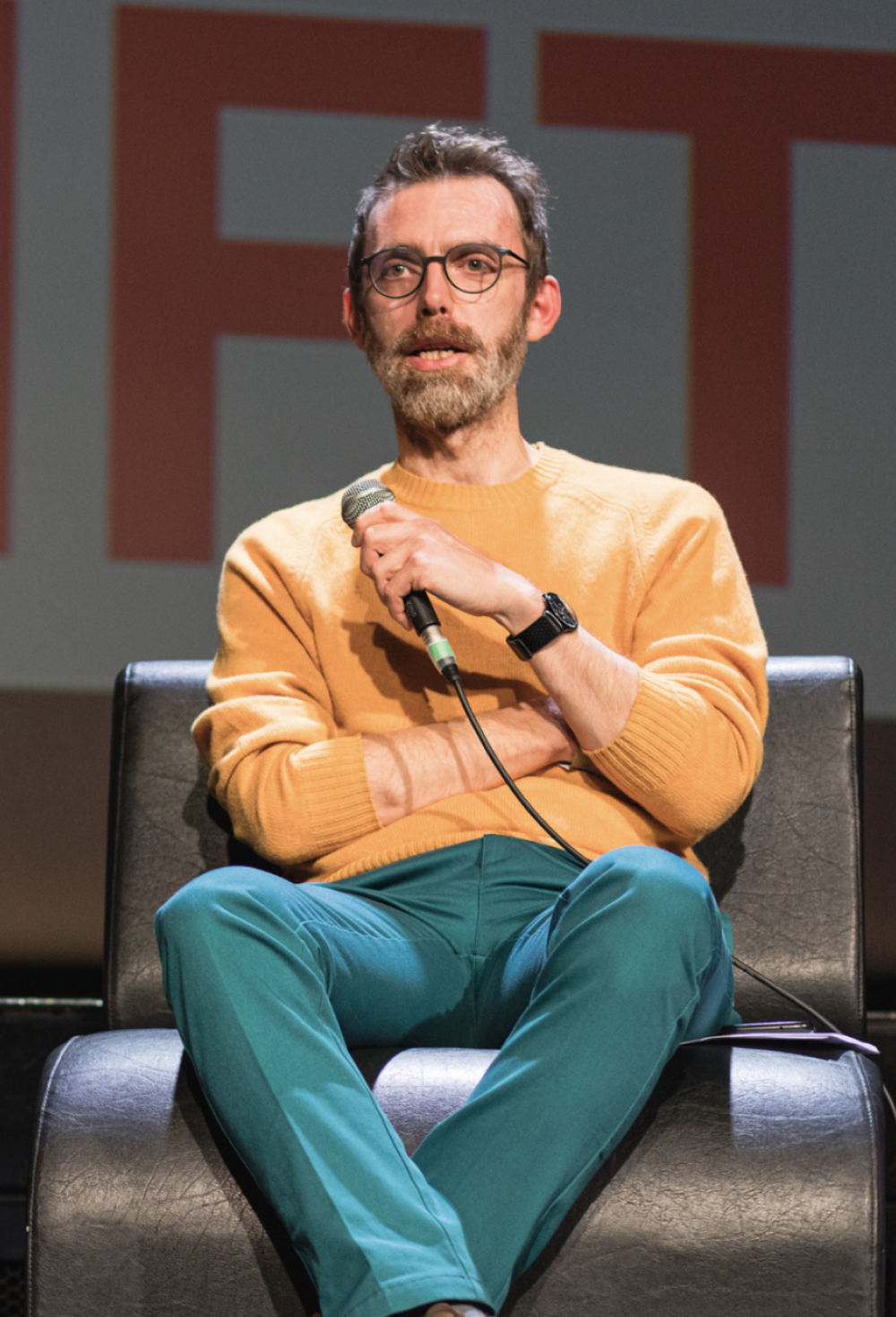
After many years in Vienna, Toronto, and London, Martin Zeilinger is currently based in Dundee, Scotland, where he holds a research and teaching position as Senior Lecturer in Computational Arts & Technology at Abertay University.
Much of his work focuses on artistic and activist experiments with emerging technologies – specifically artificial intelligence and distributed ledger technologies (also known as the blockchain). This frames a broader interest in digital art, appropriation-based art practices, theories of cultural ownership and intellectual property, political economies of new media, and aspects of experimental videogame culture. Most recently, his research has also expanded to include non-human and more-than-human agency.
A common thread running through many of his activities is the exploration of how concepts such as authorship, creativity, originality, agency, and ownership are reconfigured in emerging tech contexts; how these concepts become legally and/or algorithmically encoded in service of capital; and how digital artist/activist communities respond critically to these developments.
His monograph Tactical Entanglements: AI Art, Creative Agency, and the Limits of Intellectual Property (published in 2021 with meson press, and freely available under an Open Access license) brings many of these interests and topics together.
His most recent contribution to discourse on blockchain art and decentralised computing is Structures of Belonging, an effort to begin re-imagining blockchain technologies beyond digital property enclosures (Aksioma Postscriptum Series 2023).
On the broader topic of copyright issues in digital culture, he co-edited the interdisciplinary collection Dynamic Fair Dealing with Rosemary J. Coombe and Darren Wershler (Univ. of Toronto Press 2014).
Over the years, Martin’s writing on art and technology has been published widely in books such as Meta.space – Visions of Space from the Middle Ages to the Digital Age (Distanz Verlag 2022), the MoneyLab Reader Vol. 2 (Institute of Network Culture 2018), Artists Re:Thinking the Blockchain (Torque Editions 2017), and Sampling Media (Oxford Univ. Press 2014). His work also appears in key journals including Leonardo (2023), Culture Machine (2021), Media Theory (2019), and Philosophy & Technology (2018), and has been featured in contemporary art publications such as Spike Art Magazine and Outland.
He frequently speaks at international art organizations and festivals that focus on new media and technology, such as Aksioma (Ljubljana, Slovenia), the Bergen Center for Electronic Art (BEK) (Bergen, Norway), Uroboros Festival (Prague, Czech Republic), and Zentrum für Netzkunst (Berlin, Germany).
In addition to research and teaching, he is involved in various curatorial activities. The most long-running of these was the Toronto-based Vector Festival, which he co-directed and/or co-curated from 2014 to 2020.
He also advises artists and creative practitioners on intellectual property questions – most commonly around issues related to fair dealing/fair use. In this capacity, he has served as a consultant and/or expert witness on a number of legal cases.

