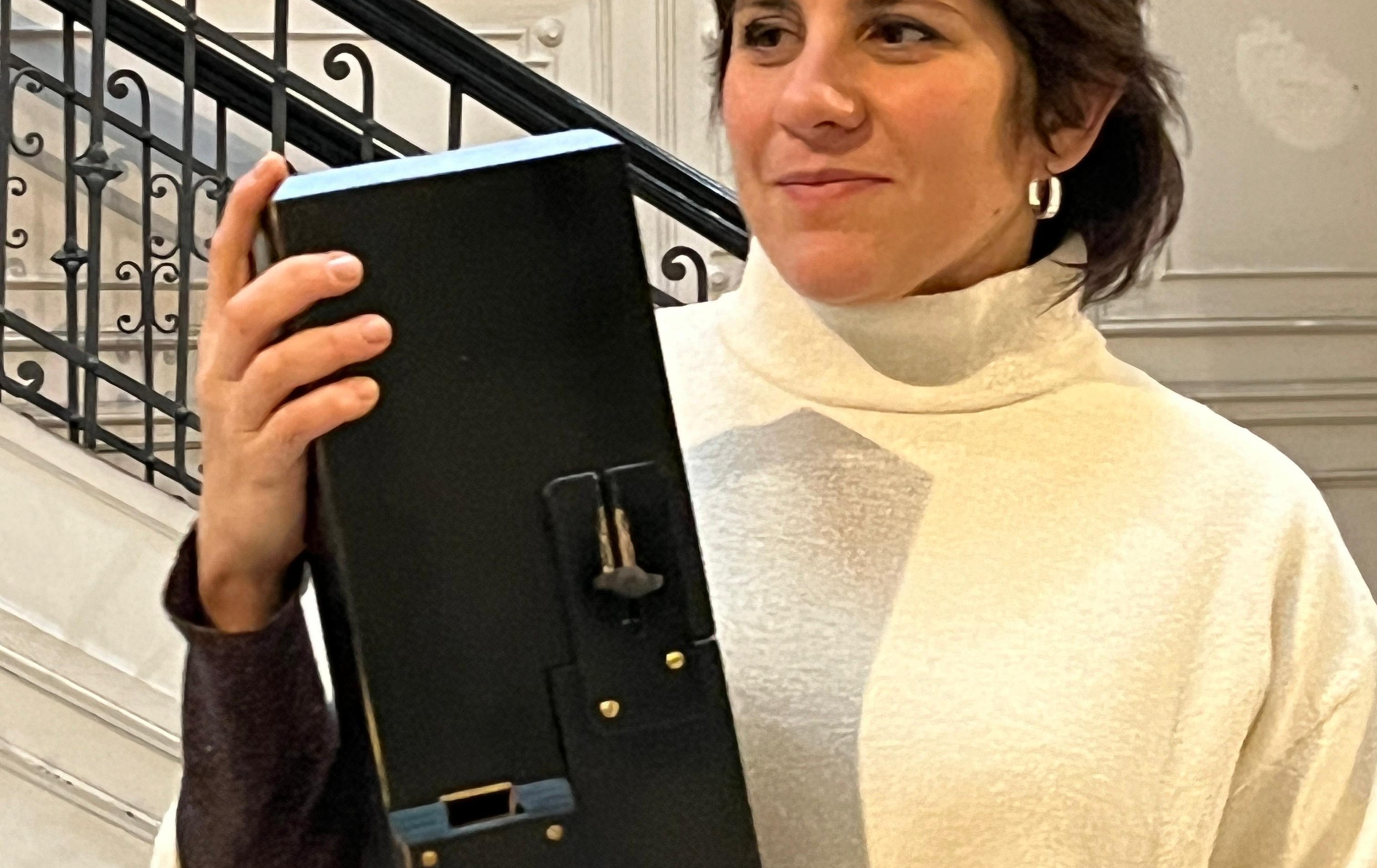
Orpheus Instituut welcomes Paola Muñoz Manuguián
News September 29, 202527 October - 7 November
Orpheus Instituut welcomes Paola Muñoz Manuguián as visiting researcher. Her research develops through trans-creation, a practice that regards musical works not as fixed texts to be represented, but as catalysts for multisensory and multidimensional performance.
Orpheus Instituut is pleased to welcome Paola Muñoz Manuguián, performer-researcher and PhD candidate at the Pontificia Universidad Católica de Chile. During her dual residency (2025–2026), she collaborates with Paulo de Assis, Juan Parra, and Diego Castro Magas to advance her concept of trans-creation.
Her work rethinks interpretation as a generative process that engages memory, resonance, latency, and spatial dramaturgy. Drawing on thinkers such as Deleuze, Guattari, and Simondon, Paola challenges conventional hierarchies between composer, performer, and instrument. Through recorders, electronics, video, and psychophysiological data, she creates performative assemblages that blur boundaries between sound, space, and image.
My research treats musical works as generative frameworks rather than representations.Muñoz Manuguián - PhD researcher at the Pontificia Universidad Católica de Chile
“My research treats musical works as generative frameworks rather than representations. Through trans-creation, I explore how sound, movement, and space interact to produce new forms of polyphony and embodied knowledge. Orpheus offers a vital context for developing these ideas in dialogue with others.” - Paola.
Her current projects include a trans-creation of Stockhausen’s Solo, integrating recorders, electronics, and neural-data-driven video, and Resonant Shadows, a site-specific work for Baroque alto recorders that explores resonance, architecture, and memory. At Orpheus Instituut, she contributes to ongoing debates in artistic research, performance studies, and the ontology of musical works.
We warmly welcome Paola Muñoz Manuguián to our institute and look forward to the perspectives her research will bring to our community.


